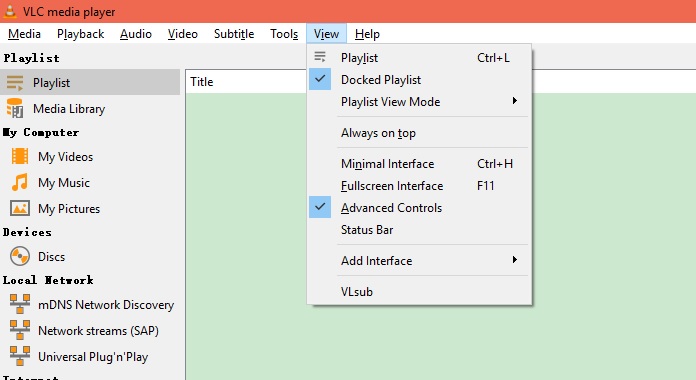
MacOS: Command+F. The best way to watch your favorite videos in VLC is. Show advanced controls in fullscreen mode Post by Triggar » Mon Jul 30, 2018 12:03 am So I have enabled Advanced Video Controls and they are present when not in Fullscreen mode,. But disappear when in Full screen.
- MacOS
Jump to: Most used, Jump in playback, Mouse actions, Movie Navigation, Manage VLC, Playlists, and Special Commands
F | Fullscreen |
Esc | Exit full screen mode |
Space | Pause or play movie |
V | Subtitles on/ off |
B | Select audio track |
Ctrl+Arrow Up/Arrow Down | Volume up/ down in 5% increments |
Vlc Mac Advanced Controls Free
Shift+Arrow Right/Arrow Left | Jump 3 seconds forward/ backward |
Alt+Arrow Right/Arrow Left | Jump 10 seconds forward/ backward |
Ctrl+Arrow Right/Arrow Left | Jump 1 minute forward/ backward |
Vlc Mac Advanced Controls Software
Scroll up/ down | Volume or Position (see settings) |
Right-click | Local menu (play controls, audio/ video) |
Ctrl+D | Open Disc menu |
Ctrl+F | Open Folder (browse folder menu) |
Ctrl+R | Advanced open file |
Ctrl+O | Open single file(s) |
M | Mute and unmute audio |
P | Play movie (from the very beginning) |
S | Stop movie (not pause; this stops the movie completely) |
[/ ] | Increase/ decrease playback by 0.1x |
= | Adjust playback to normal (1.0x) |
C | Change screen Crop 16:10, 16:9, 4:3, etc. |
A | Change Aspect ratio 16:10, 16:9, 4.:3, etc. |
G/H | Decrease/ increase subtitle delay |
J/K | Decrease/ increase audio delay |
Z | Change zoom mode |
Ctrl+1 ... 4 | Play Recent media (in Media - Recent media menu) |
T | Show time |
Ctrl+T | Goto time |
E | Frame by Frame Mode; continue pressing E to advance one frame at a time. |
Ctrl+H | Hide Control |
Ctrl+P | Preferences/ interface settings |
Ctrl+E | Adjustments and audio/ video Effects |
Ctrl+B | Edit Bookmarks |
Ctrl+M | Open Messages |
Ctrl+N | Open Network |
Ctrl+C | Open Captue device |
Ctrl+L | Open PlayList; press again to return to movie. |
Ctrl+Y | Save playlist |
Ctrl+I | Media Information |
D | Toggle Deinterlace |
N | Play next movie from playlist |
P | Play previous movie from playlist |
F1 | Show help |
F11 | Window full-screen (not equal to pressing F) |
Ctrl+W | Quit VLC |
Created by admin on 5/8/2009. Last updated by newduke on 6/17/2020
0 Comments for 'VLC Media Player '
Frequently Asked Questions
view this alone
- 3Latest developments
- 3.2Command line
Graphical Interface
Many people who want to use VLC media player on macOS will be intending to use the standard graphical interface that is provided by VLC. The standard interface consists of the eight menus in the menu bar and the 'VLC - Controller' window that opens up by default. This section outlines what VLC can do for you (at V0.8.6a current active is V3.0.12) and will be completed as I check the use of menu options.
The ten menu bar options are listed below along with the main interesting capabilities under each menu item:
- VLC which allows you to check for an updated application, to access the preferences, and to add an interface.
- File which allows you to open a media file, or an associated file (such as subtitles). It also has a wizard to allow the streaming of video, or the capturing of a streamed video to a file.
- Edit which does nothing VLC-specific.
- View which allows you to hide or show various options like previous/next buttons, shuffle and repeat, audio effects, sidebar, as well as customize what you see in 'playlist table columns'.
- Playback allows you do do all the things you might expect from a video player; some of these features are duplicated graphically in the 'Controller' window.
- Audio allows you to control the audio level, as well as the output device and the audio track to use from the input.
- Video allows you to control the video display on your screen, as well as which device to display on, and which video source to show in that display.
- Subtitles allows you to add subtitle files to your video, as well as change the appearance of subtitle text for your video.
- Window allows you to display seven helper windows that will display information about VLC's activity, and control more detail of that activity.
- Help gives access to the help that came with the installation, the help info on the VideoLAN site, and access to interaction mechanisms with the VLC developers.
In general, many users find that they can get what they want from VLC 'straight out of the box', and may only want more advanced controls after becoming familiar with the regular interface.
Keyboard Shortcuts
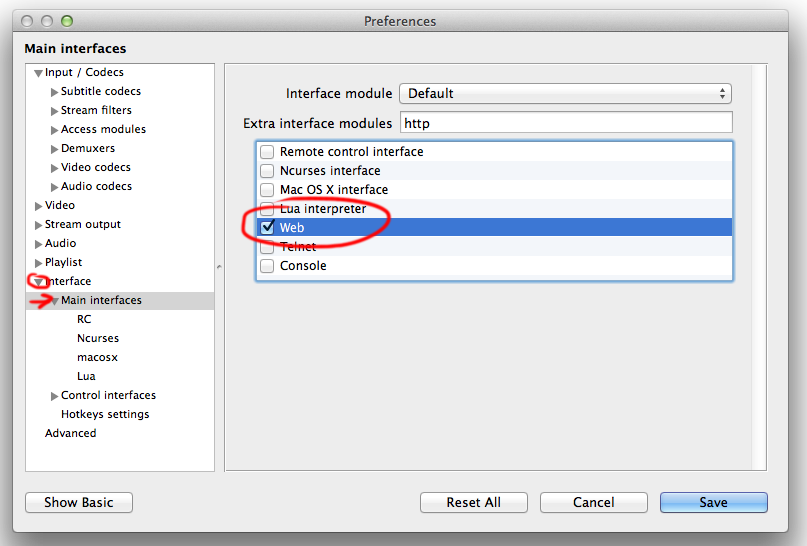

You can find most of the keyboard shortcuts by taking a look at the menus. Additional hotkeys are defined in the section 'Hotkeys' of your VLC preferences.
Some handy key combos are:
- Spacebar – pause/unpause the video
- ⌘ + F – toggle fullscreen (Escape will also exit fullscreen)
- ⌘ + Shift + left/right arrow keys – jump the video back/forward about a minute
- ⌘ + Ctrl + left/right arrow keys – jump the video back/forward about ten seconds
- When watching a DVD, and the video window is the front-most window, arrow keys and the enter key will allow you to navigate the DVD menus
- F key – Decrease Audio Delay in milliseconds
- G key – Increase Audio Delay in milliseconds
- H key – Decrease Subtitle Delay
- J key – Increase Subtitle Delay
Latest developments
Streaming Wizard

A streaming wizard has been available since the VLC media player 0.8.4 release. This is available under the 'File' menu.
Command line
You can run VLC on macOS using a terminal application (for example Terminal.app in /Applications/Utilities) with the following command:
On most Bourne-like shells, you can set an alias to just vlc with the following command:
It can be helpful to add this command to your shell setup file.
This option can also be activated from the 'VLC' menu.
Command line examples
~ will expand to /Users/<username>
Following command does this: Transform video-filter (flip vertically), transcode (save) to file.
-I rc is so that it doesn't open the GUI, but stays on the command line version--vout-filter defines the filter to use--transform-type defines the attributes of the transform filter/Movie.mov is the file to convert--sout= is the stream output chain/output.mp4 is the output file name
Another Example
I had a heck of a time getting this to work the way I wanted it. I kept attempting a command-line execution of VLC to only get the following response (not what I wanted):
What I wasn't doing apparently was specifying the location of the source movie.
Eventually I ran this:
HINT:
This would be the same as if you didn't have an alias for vlc that pointed to the actual Applications executable:
Hopefully, I'll add to this post when the transcoding finishes and I see my results (I have no idea if I've got the correct options for vp8/vorbis webm-container transcoding).....
No Dock
In previous versions you can replace the VLC at the end of the path with clivlc to suppress the launch of any Mac-like interface (VLC wouldn't even appear in the Dock then) or if transcoding from the command-line crashed with a Bus error.
This does not work anymore (see Forum thread #58378)

As given by Command-line interface#macOS, specify the option -I followed by the interface you want to add e.g. VLC -Idummy.
Need Help?
See the FAQ on macOS only issues or the Common Problems pages.